
SPECIAL HAVE A CUP OF JOE WITH JOE
THE GORDIE HOWE INTERNATIONAL BRIDGE . . . JOINING TWO NATIONS TOGETHER
UPDATE TO COVER STORY: Canada and Michigan, with the backing of the U.S. government, have agreed to open the Gordie Howe International Bridge (GHIB) on July 27, 2026.
Spanning the Detroit River between Windsor, Ontario and Detroit, Michigan — and ‘Spanning the Future’ — the GHIB is the result of a decade of intense collaboration. It will serve as a major regional economic driver, providing a crucial new route for commuters, tourists, and commercial traffic. It is set to strengthen North American supply chains, bolster manufacturing, and streamline the movement of travelers and essential goods.
With hundreds of millions of dollars in trade already crossing the Windsor-Detroit corridor daily, it ranks as the busiest international land border crossing in North America. The new bridge will solidify this vital economic link between Canada and the U.S., driving billions of dollars in economic activity for decades to come.
BELOW IS OUR JUNE FEATURE….
Few recent Canadian infrastructure achievements carry as much significance for Windsor Essex, southern Ontario, and the national economy as the Gordie Howe International Bridge (GHIB).
“The Gordie” is a once-in-a-generation milestone for Canada.
At a cost of $6.4 billion, the bridge is more than a major construction project. It is a long-awaited trade corridor, a source of civic pride, and a transformative public work that will reshape cross-border movement between Canada and the United States.
The Windsor–Detroit border is widely regarded as North America’s most economically significant international land crossing. For nearly a century, it has anchored the continental economy and served as a vital link in the just-in-time supply chains that sustain the automotive, manufacturing, and agricultural sectors. Historically, this corridor has carried roughly 25 to 30% of all surface trade between Canada and the United States. On a typical day, between $300 and $325 million in goods cross the Detroit River. Since auto parts often move across the border multiple times during vehicle assembly, even short disruptions can ripple quickly through factories across Ontario, Michigan, Ohio, and Indiana.
Marta Leardi-Anderson — a prominent figure in regional infrastructure and cross-border policy — is the Executive Director of the Cross-Border Institute at the University of Windsor. The institute was founded in 2008 and is dedicated to research, education, and public outreach related to the movement of people, goods, and funds across borders.
Leardi-Anderson comments on the importance of the GHIB: “The Gordie is built for purpose infrastructure; created specifically to manage commercial and passenger traffic with efficiency and the highest levels of security. It will be a critical part of the very successful Canada-U.S. trade corridors and those crossings currently providing border services for the movement of goods and people, some at the busiest land border crossings in Ontario.”
What follows is an overview of the bridge’s defining features, along with a look back at the decades-long effort that finally brought the project to completion.
This summary draws on official fact sheets, news releases, published reporting, and project materials to provide readers with a concise and accessible account of the Gordie Howe International Bridge (See their website stocked with all kinds of wonderful details, but do this after reading my article, LOL!).
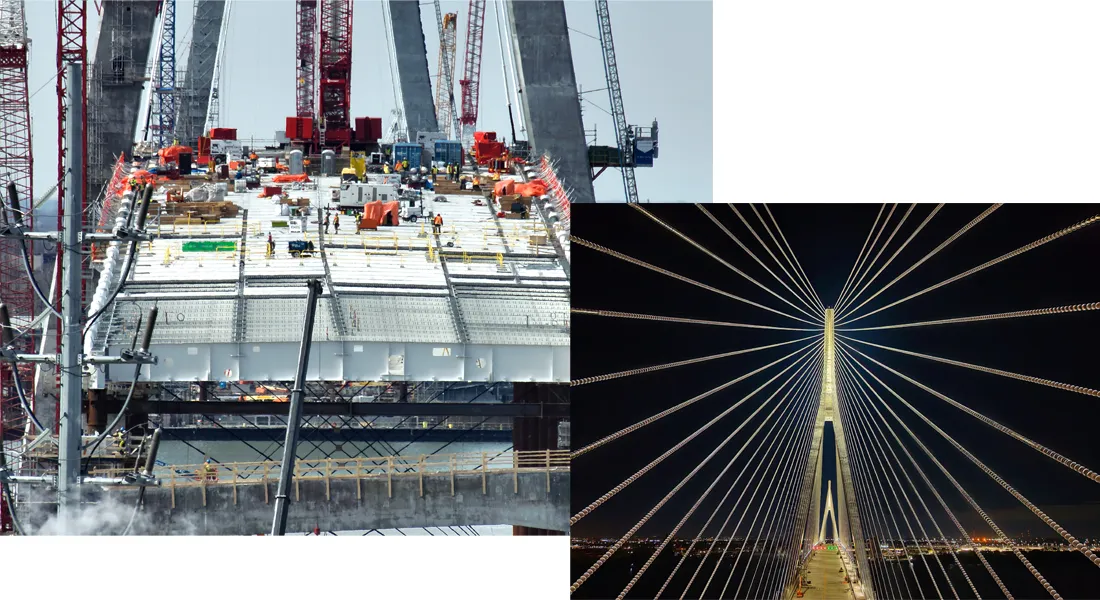
The GHIB is the longest cable-stayed bridge in North America, with an 853-metre main span over the river between its two towers. Its distinctive A-frame design supports a cable-stayed deck with a minimum clearance of 42 metres (approximately 138 feet) above the Detroit River’s high-water level, allowing commercial shipping to pass below without interruption. The two main towers rise about 220 metres (722 feet), rivaling the height of Detroit’s Renaissance Center.
It isn’t just the bridge itself; it also encompasses the Port of Entry (POE) customs facilities on both sides of the river. The Canadian POE is situated on 130 acres, while the U.S. POE sits on 167 acres. Including its approach ramps and direct highway connections to the Right Honourable Herb Gray Parkway/Highway 401 in Windsor and I-75 in Michigan, the full highway-to-highway transportation corridor stretches 16 to 17 kilometres (10 to 10.5 miles).
For both Windsor and Detroit, the new crossing promises long-needed relief from truck congestion that has burdened inner-city streets for decades.
The bridge is built to manage high volumes of commercial and passenger traffic while allowing for future growth. It has six vehicle lanes — three in each direction — at standard highway width to accommodate heavy long-haul trucks, which account for a large share of Windsor-Detroit corridor traffic.
Unlike the older Ambassador Bridge, the GHIB includes a dedicated Multi-Use Path (MUP) for cyclists and pedestrians on its east side, separated from vehicle traffic by a concrete barrier for safety. The path connects to Windsor’s local trail network, including the Herb Gray Parkway Trails, and to Detroit’s Iron Belle Trail system. The Multi-Use Path is toll-free.
“The Gordie Howe International Bridge and its Multi-Use Path speak to the growing connectivity between Windsor and Detroit, and the exciting opportunities it creates for visitors to experience our destination in new and active ways such as cycling across an international border,” expresses Gordon Orr, CEO of Tourism Windsor Essex Pelee Island.
