
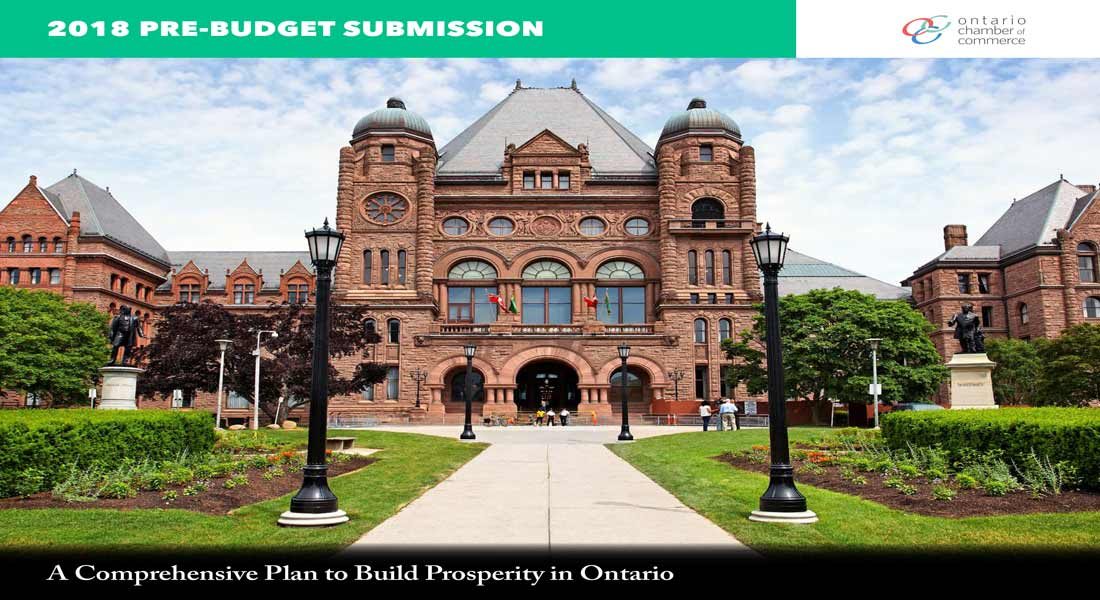
Windsor-Essex Regional and Ontario Chambers Call for Tax Reform, Smart Spending to Support Ontario Businesses and Communities
Today, the Windsor-Essex Regional Chamber of Commerce (WERCC), in partnership with the Ontario Chamber of Commerce (OCC) provided the Ontario government with 11 recommendations for the upcoming provincial budget that will help businesses manage costs, offer smart spending ideas, and help secure the province’s competitive advantage.
“Employers of all sizes in the Windsor-Essex region are feeling the pressure and uncertainty from rising costs including a 400% increase in electricity costs, cap & trade costs, NAFTA uncertainty, border uncertainty, and the implementation of Bill 148. The WERCC is concerned about business confidence in Ontario’s economy,” said WERCC President & CEO Matt Marchand.
“Ontario needs comprehensive tax reform that encourages investment, reinvestment, and reduction in red tape, such as one-stop shopping as described in the WERCC’s non-partisan Policy and Solutions Forum in 2016,” said Marchand. “In addition, as the U.S. implements one of their largest tax reforms in 30 years that essentially negates Ontario’s previous tax advantages, we must find more ways to keep Ontario competitive.”
Ontario’s Chamber Network is recommending the government reinstate the scheduled corporate income tax rate from 11.5 per cent to 10 per cent. The submission also calls on the harmonization of the Business Education Tax across the province, as well as targeted reductions to the Employer Health tax.
Another recommendation includes gradually increasing the “Heads and Beds Levy” on institutions to $100 per bed and then tie future yearly increases to the Consumer Price Index (CPI). Since 1987, the annual in lieu of taxes or “Heads and Beds Levy” on specified institutions has not been raised from $75. Municipalities with post-secondary institutions, hospitals, and correctional facilities face significant competitive disadvantages when compare to other municipalities and must make up for lost revenue in other ways, including property tax increases. The economic impact of the increase could be realized by municipalities, such as Windsor-Essex, immediately.
The Ontario Chamber Network is also asking the government to preserve tax exemptions of private health and dental plans. Taxation of private health and dental plans could potentially place a heavy cost on a strained primary health care system and would likely translate into a loss of coverage for approximately one million Ontarians and their dependants.
The recommendations outlined in the OCC’s pre-budget submission all come directly from Ontario’s Chamber Network through policy resolutions at the OCC’s AGM.
Read the 2018 Pre-Budget Submission and all 11 recommendations.
