
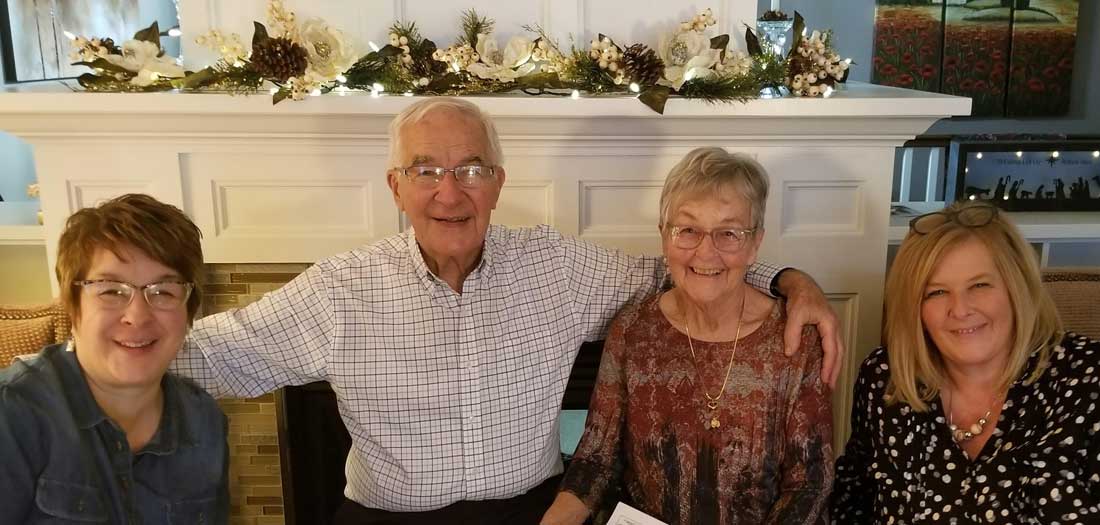
Grandmother of Five with Incurable Cancer is Helping Researchers Get One Step Closer to a Cure at the 10th Annual Windsor/Essex County Multiple Myeloma March
n 1997, Joanne Ternovan, a busy mother of two young adult daughters, worked as a substitute teacher at a local primary school. After a routine check-up with her family doctor, her life turned upside down. The results of her blood work had come back abnormal. After further investigation, in the fall of 1998 Joanne was diagnosed with multiple myeloma, a little-known and incurable cancer of the plasma cells. She was just 58 years old.
“I was shocked when I got the news. I didn’t have any pain or any symptoms. I couldn’t understand it. I didn’t have a clue what myeloma was. And when my doctor told me that it’s an incurable cancer, I was terrified and in total disbelief. My daughters were young women. I wanted to be around to see them have families of their own and be involved with their children.” – Joanne Ternovan
Within a year, Joanne started experiencing debilitating back pain – a common symptom of myeloma caused by lesions in the vertebrae – that ultimately forced her to stop working. In consultation with her doctors, she began a treatment regime to slow the progression of the myeloma and prepare her for a stem cell transplant. On July 1, 2000 at the age of 60, Joanne underwent the procedure. Shortly after, she was thrilled to learn that the transplant was a success and that she was now in remission. Two years later to avoid a relapse, Joanne participated in a local clinical trial. Great news followed in 2003 when Joanne found out her condition was deemed stable and that she was able to stop all treatments. Joanne credits her good fortune not only to the life-saving drug therapies she had access to, but also to the love and support of her husband of 58 years, Mike, and their two daughters Susan and Cathy. “Mike is my savior. I don’t think I could have managed without him,” says Joanne. Joanne’s fear that the cancer will one day resurface is always present so she does what she can to stay positive, thankful and busy.
To help her cope with the disease, Joanne joined the Windsor & District Multiple Myeloma Support Group in 1999. As one of the longest-living myeloma patients in her community, she has become an integral part of the group, providing hope and inspiration to others. “When I was first diagnosed, I had so many questions, yet I didn’t have anyone to turn to,” said Joanne. Over the years, she has connected with many people with many different journeys. Yet, regardless of the variations in which each person experiences this difficult and complicated disease, the one thing that remains invariable amongst everyone is the desire to find a cure.
Over the past 22 years, Joanne has seen, first-hand, the life-changing impact that advances in myeloma research are having on the lives of those living with this incurable cancer. Joanne and her family are more intent than ever to raise awareness and funds for myeloma, and will be participating in Myeloma Canada’s 10th annual Windsor/Essex County Multiple Myeloma March on Sunday, September 27, at 9 am.
“I feel like one of the lucky ones,” says Joanne, who is now 80 years old. “I’ve had the privilege of playing an active role in the lives of my five grandchildren. I want that for others. I want to share a message of hope for other patients,” adds Joanne. “With the incredible advances in research and new drug treatments, myeloma isn’t necessarily a death sentence any longer. Science is getting closer to a cure and I want to do my part in ensuring that it happens,” adds Joanne.
This year’s Windsor/Essex County Multiple Myeloma March has been modified to help stop the spread of COVID-19. In compliance with physical distancing measures, participants are encouraged to hold their own walk in their neighbourhood at the same time as their regularly scheduled event: September 27. Joanne and her fellow Windsor/Essex County Marchers have set their fundraising goal at $40,000 to help further critical research for this deadly blood cancer that affects nine new Canadians every day.
“Myeloma research has produced extremely promising results over the past two decades. In fact, for the first time there’s a cure in sight,” says Dr Sindu Kanjeekal, Hematologist/Oncologist, at Windsor Regional Hospital. “We can’t afford to let the current situation stop the progress we’ve made and put vulnerable people living with myeloma at risk, which is why it’s more crucial than ever to invest in research and find a cure.”
The Multiple Myeloma March, Myeloma Canada’s flagship fundraiser is now in its 12th year. This year, funds raised by the Multiple Myeloma March will go directly to support Myeloma Canada’s Myeloma Research Priority Setting Partnership (PSP), an important initiative that uses community input to identify and define future investments in myeloma research. The annual five-kilometer event brings Canadian communities together to raise essential funds for research and to help improve the lives of all Canadians impacted by myeloma. Windsor/Essex County is one of a record 33 communities across the country to be included in this year’s Multiple Myeloma March. The national fundraising goal is set at $650,000. To learn more about how this event will be working, please click here.
“While this year’s March will undoubtedly be different because of the pandemic, it’s crucial to stay positive,” says Martine Elias, Executive Director of Myeloma Canada. “Fundraising has taken a huge hit for many organizations. We need to do all we can to increase awareness and raise essential funds for research that will improve the lives of Canadians impacted by myeloma, and bring us closer to a cure,” Martine added. “As we mark Myeloma Canada’s 15th anniversary, we celebrate the strength of our incredible community. More than ever, we’re counting on our supporters to help us achieve our goal of $650,000. Canadians impacted by this incurable cancer are depending on us.”
Multiple myeloma, also known as myeloma, is the second most common form of blood cancer. Myeloma affects a type of immune cell called the plasma cell, found in the bone marrow. Every day, nine Canadians are diagnosed, yet in spite of its growing prevalence, the disease remains relatively unknown. While there is no cure, people with myeloma are living longer and better lives, thanks to recent breakthroughs in treatment. To find the cure, more funding and research are required.
This year marks the 15th anniversary of the creation of Myeloma Canada, the only national charitable organization created by, and for, Canadians impacted by multiple myeloma. The organization is driven to improve the lives of those affected by myeloma by empowering the community through awareness, education and advocacy programs, and supporting research to find a cure. Since its founding in 2005, Myeloma Canada has been making myeloma matter.
